Managers & supervisors
Understand the environmental responsibilities increasingly built into operational roles.
Gain practical, regulated knowledge to help identify, manage and improve environmental performance across your organisation.
Designed for managers, supervisors and developing professionals who need a clear understanding of organisational environmental management.
Understand the environmental responsibilities increasingly built into operational roles.
Broaden your remit where environmental management overlaps with compliance and risk.
Build awareness of impacts, controls, legislation, monitoring and improvement.
Create a regulated foundation before moving into higher-level sustainability roles.
The ProQual unit contains eight major learning outcomes. SHEC Learning® presents them as eight clear learning modules.
60-question multiple-choice examination
90 minutes available
Pass / fail result
This is SHEC Learning®’s current approved-centre delivery arrangement.
ProQual describes internally assessed evidence across the qualification, with external quality assurance. Permitted methods include assignments, projects, reports, worksheets, portfolio evidence and questioning.
Progression should reflect your experience, responsibilities and career direction—not simply follow the next number.
Core environmental-management knowledge for emerging responsibility.
For experienced practitioners with broader sustainability responsibility.
Explore Level 6 →For senior leaders shaping environmental strategy and organisational performance.
Explore Level 7 →A regulated Level 3 qualification providing foundation knowledge in organisational environmental management.
603/6603/5.
There is one mandatory ProQual unit. Its eight major learning outcomes are structured by SHEC as eight learning modules.
30 Total Qualification Time hours, including 20 Guided Learning Hours.
ProQual specifies no formal entry requirements.
No. It is a foundation knowledge Award and does not by itself demonstrate occupational competence.
SHEC Learning® delivers the course entirely through e-learning, with six months of course access.
The current SHEC Learning® offer uses a 60-question multiple-choice examination with 90 minutes available.
It introduces relevant environmental-management-system and ISO-standard concepts. It does not make you an ISO 14001-certified auditor.
Yes, particularly where environmental responsibility is becoming part of the role. As an entry-level e-learning course, no suitability assessment is required.
Enrol online or speak with SHEC Learning® about your environmental career pathway.
Develop a structured approach to investigating workplace accidents, finding root causes and preventing recurrence.

New Release
Run by Nigel Lewis


Certification
Course Level
Study Time
Course Type
This CPD-certified e-learning course gives construction supervisors, managers, health and safety professionals, facilities teams and operational staff a structured approach to workplace accident investigation. It covers incident response, evidence gathering, interviewing, root-cause analysis, SMART corrective actions, report writing and organisational learning. It supports professional development and safer decision-making; it does not by itself prove occupational competence.
Download Syllabus for Complete Details
Accredited Certification
Earn a CPD-accredited certificate on the same day you complete your training.
Fast, Flexible Learning
Allow around 15 hours to complete, with up to six months' access from desktop, tablet or mobile.
Aligned with UK Duties
Covers incident response, evidence gathering, root-cause analysis and corrective action in line with recognised UK safety-management good practice.
Ideal for All Roles
Ideal for construction supervisors, managers, safety professionals, facilities teams and anyone involved in investigating workplace incidents.
Bulk Discounts Available
Speak to us about group training packages.
The course combines practical guidance, examples and a final multiple-choice assessment. Learners work through the modules at their own pace.
Ten focused modules plus a final online assessment.


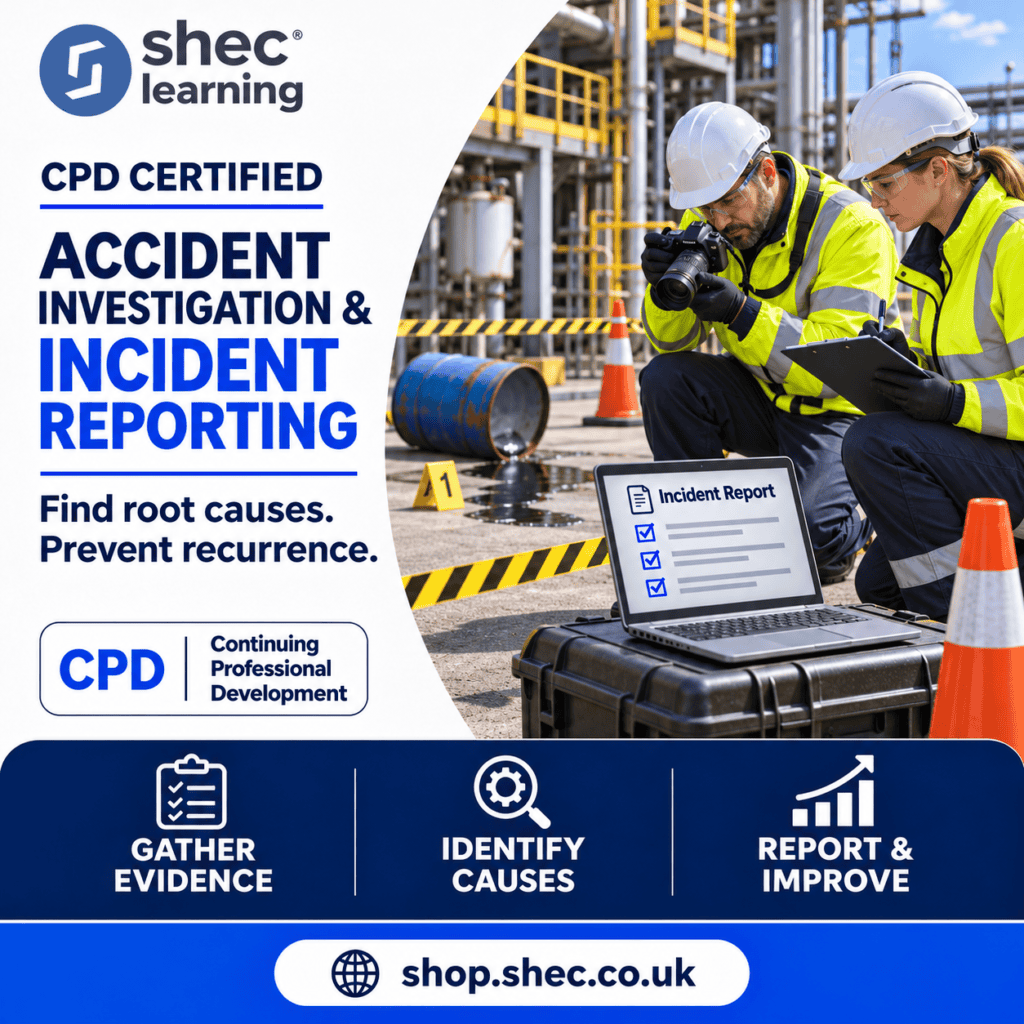
You investigate incidents, gather evidence or contribute to corrective actions.
You want recognised CPD evidence without claiming occupational competence.

Build a clear, evidence-led approach to incident response, investigation, reporting and organisational learning.
Secure the scene, preserve evidence and plan a proportionate investigation
Gather reliable evidence through observation, records and structured interviews
Use root-cause techniques to distinguish immediate, underlying and organisational causes
Write clear reports and recommend SMART corrective actions that help prevent recurrence

Safety professionals, supervisors, managers, facilities teams and anyone who may investigate workplace incidents. No prior qualification is required.
Becoming a fire risk assessor requires more than learning how to complete a form. Professional competence develops through fire-safety knowledge, appropriate qualifications, practical experience, professional judgement, accurate reporting, continuing professional development and working within the limits of your competence.
There is no single route for everyone. Your right starting point depends on what you can already demonstrate.
Your existing knowledge and experience determine where development should begin. General Health & Safety experience is valuable, but it does not automatically prove occupational fire-risk-assessment competence.
Build a Foundation-level understanding before progressing into supervised assessment activity and real building experience.
Use transferable risk skills while developing specific fire-safety knowledge, building understanding and practical FRA experience.
Develop specialist competence around the premises, occupants, management systems and fire precautions you work with.
Map current evidence against modern competence expectations, identify genuine gaps and progress at the appropriate level.
Foundation development for people building specific fire-risk-assessment knowledge.
Intermediate development with substantially more practical competence and professional reporting.
The government has committed to introducing mandatory independent certification for fire risk assessors in England. The consultation closed on 18 June 2026. As of September 2026, the final framework and implementation arrangements have not yet been brought into force.
This means fire risk assessment is not currently a regulated profession with mandatory certification, although assessors must still be competent for the work they undertake and duty holders must ensure assessments are suitable and sufficient.
This section should be reviewed when government proposals or legislation change.
Structured learning and assessment against defined outcomes, awarded by a regulated awarding organisation.
Independent verification of competence against the rules and standards of a certification scheme.
Recognition through a professional register or body, normally subject to competence, conduct and CPD requirements.
Completing a SHEC qualification does not automatically provide certification, professional registration or unrestricted competence.
✓ Observe experienced and competent assessors.
✓ Begin with simpler, lower-risk premises.
✓ Complete supervised assessment activity.
✓ Receive feedback on findings and reports.
✓ Build evidence across different premises and scenarios.
✓ Develop knowledge of construction and fire protection.
✓ Increase complexity gradually.
✓ Refer work beyond your competence to specialists.
No single degree route is required. You need relevant knowledge, training, experience and other qualities appropriate to the work you undertake.
Yes, but general H&S experience alone is not enough. You must develop fire-specific knowledge and supervised practical experience.
Yes. Facilities and property experience can be a strong starting point, provided fire-specific competence is developed and evidenced.
Potentially. Current ProQual entry permits the Level 3 Award or at least three years’ proven occupational fire-risk-assessment experience, subject to suitability assessment.
Knowledge can be developed online, but professional competence also requires practical experience, assessment activity and evidence that cannot be replaced by online study alone.
There is no universal timescale. It depends on your starting knowledge, access to practical experience, qualification route and the scope of work you intend to undertake.
It is a framework describing competence for individual fire risk assessors at Foundation, Intermediate and Advanced levels. It is not itself a qualification or a step-by-step assessment method.
No. Competence must always be matched to the premises, risks and complexity of the assessment.
Tell SHEC about your background, experience and intended role. We will help you identify the development route that matches what you can already demonstrate.